

Attention: Urban Séjour does not offer this type of contract for its furnished accommodation.
SUMMARY OF THE FEATURES OF THE MOBILITY LEASE
- From 1 to 10 months maximum
- For furnished accommodation only
- Non-renewable lease: the owner automatically gets the property back at the end of the lease, and only a standard lease can be offered at the end of the tenancy. However, it may be renewed once, if the initial term was less than 10 months, for a maximum total term of 10 months.
- No security deposit can be demanded from the tenant.
WHAT IS A MOBILITY LEASE AND HOW DO YOU SIGN ONE?
The ELAN law was enacted on 23 November 2018 and, in Article 107, introduces a new type of tenancy agreement: the mobility lease.
Le mobility lease is a contract signed between the owner of a furnished flat and the tenant, for a period of between 1 and 10 months. The rented accommodation can be called " apartment hotel "This is because they are equipped with everything the tenant might need during their stay.
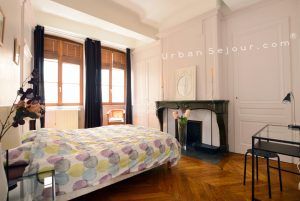
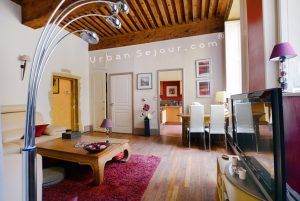
THE REASON FOR RENTAL
The mobility lease is a lease contract signed between the owner of furnished accommodation and a "temporary" tenant (student, apprentice, employee on assignment or vocational training, etc.). The reason for the stay must be professional mobility.
On the effective date of this lease, for the tenant to be able to rent a furnished property, he or she must be in one of the following situations:
- Professional training
- Higher education
- An apprenticeship contract
- An internship
- A voluntary commitment to civic service,
- A professional transfer,
- A temporary assignment as part of a professional activity.
The tenant is also obliged to provide a receipt when the lease is signed (certificate from employer, training centre/university, etc.).
If the tenant cannot provide proof of a business reason, he or she will have to rent the flat in seasonal rental (for stays of up to 90 days), or traditional year-round rental (classic rental contract).
Subletting is possible if the tenant obtains permission from the landlord. Shared tenancy is also possible. However, the contract may not contain a clause providing for joint and several liability between the joint tenants or their guarantors.
WHO CAN BÉNÉBENEFIT FROM THE MOBILE LEASEÉ ?
As indicated by the fact that a mobility lease must be entered into for professional reasons, the tenants eligible for this type of lease are necessarily professionals who are away on business or in training. What's more, there is no age requirement for mobility leases.
These may include, for example:
- The studentsWherever your place of study is, Urban Séjour can offer you a comfortable apartment hotel in Lyon, including EM Lyon, Centrale Lyon, UCLy Catholic University, Lumière Lyon 2 University, Jean Moulin Lyon 3 University, Claude Bernard Lyon 1 University, etc;
- TraineesThese include medical or paramedical trainees at HCL / Hospices Civils de Lyon or Hôpital de la Croix Rousse, or trainees in other fields;
- Professionals on the move who are coming to Lyon for an assignment or a transfer, including executives (or other employees), professionals coming to Lyon for a trade show (such as the Sirha trade show or the Foire de Lyon), or even doctors, researchers, doctors and doctoral students, teams of workers, theatre companies... Urban Séjour offers furnished flats suitable for business stays ;
- Expatriate professionals returning to France with their families and looking for a job. temporary accommodation or even a flat for a long period.
Whatever your field of activity, the reason for your business trip or the location of your workplace, Urban Séjour will be able to offer you suitable temporary flats.
LENGTH OF STAY
This contract is for a term of between 1 and 10 months. Le mobility lease cannot be renewed or extended. However, the duration of the lease may be modified once, by amendment, up to a maximum of 10 months.
At the end of the lease, the contract is automatically terminated. However, if the tenant and landlord sign a new lease for the same furnished property, the new lease must be for a furnished tenancy (renewable one-year contract).
WHICH HOMES CAN BE RENTED UNDER A MOBILE LEASE?
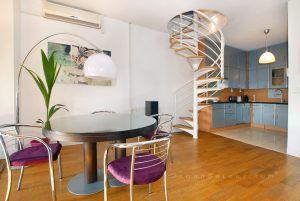
The accommodation concerned by the mobility lease must be furnished and equipped. (An empty, unfurnished flat will not qualify for a mobility lease). The tenant must be able to move in with his or her personal belongings without needing to bring any equipment into the accommodation in order to live there comfortably. Accommodation rented under a mobility lease should include the same facilities as furnished tourist accommodation, i.e. the flat should be decent and include minimum furnishings (fitted kitchen, tables, chairs, lights, storage shelves, bedding, etc.).

TERMINATION OF THE MOBILITY LEASE
The tenant may terminate the contract at any time, subject to a period of 1 month's notice. The owner cannot terminate the contract before the end of the lease term (except in the event of a breach of contract).
SECURITY DEPOSIT AND GUARANTEE
Unlike temporary or annual rental contracts, where the tenant is often required to pay a deposit of one or two months' rent, the landlord is prohibited from collecting a security deposit.
However, the landlord is authorised to ask for a deposit. In this case, the tenant can make use of the Visale guarantee:
- Students or young people on work-linked training schemes
- Or the other tenants.
On the tenant's arrival and departure, an inventory of fixtures is carried out with the owner or his representative (caretaker/agency) to identify any damage.
CONTENTS OF THE MOBILITY LEASE CONTRACT
Taking into account the above rules, the mobility lease must provide the following information:
- The name and address of the owner
- The tenant's name and address
- The date on which the contract takes effect
- The duration of the lease
- The business reason for a mobility lease
- The following sentence: The rental contract is a mobility lease governed by Title 1 ter of Act 89-462 of the Act of 6 July 1989 on improving relations between tenants..
- The purpose and floor area of the flat
- A list of fixtures and fittings for the exclusive use of the tenant, as well as private and communal areas
- The rent and payment terms (monthly payments, for example)
- An explanation of the work carried out in the flat since the end of the last contract
- A statement to the effect that no security deposit is required.
The mobility lease at Urban Séjour
The accommodation managed by Urban Séjour is ideally suited to rental under a single-occupancy contract. mobility lease. Many professional tenants, both French and international, opt for the renting our flats on a mobility lease. They may be individual professionals, or companies that conclude a mobility lease for one of their employees on a professional assignment.
All our accommodation is tastefully furnished and very well equipped for a professional stay, and all charges and taxes are included in the rent.
Charges such as water, electricity, gas, internet etc. are included in the rent. The flat rate is based on "normal" consumption, as specified in the rental agreement. our General Terms and Conditions.
During the stay, Urban Séjour remains at the disposal of the tenants for any administrative or other needs (issue of accommodation certificates, receipts, etc.).
How do you declare a mobility lease and what are the tax implications?
For the seasonal rentalIf you wish to rent a furnished flat for a short period of up to 90 nights, the accommodation must first be declared to the local council as furnished tourist accommodation. The mobility lease does not require such a declaration.
On the other hand, the choice of a mobility lease has no consequences for the owner's tax regime. tax receipts are taxed under the traditional / classic furnished rental.
If the owner receives less than €70,000 in rental income per year and has not opted for the actual scheme, the microfoncier scheme will be applied, which has an allowance of 50%.
On the other hand, if the owner is subject to the "régime réel" or earns more than €70,000 a year, he or she will be able to deduct all his or her charges and expenses and apply depreciation. If there is a property deficit, the deficit will be deductible from the owner's income, depending on the regime to which they are subject: either the "professional furnished lettings" regime (also known as LMP), or the "non-professional furnished lettings" regime (also known as LMNP).